Saturday, May 5, 2018

A Barnsley hayrake table 3, making the tabletop

With the frame of the table completed, I started making the tabletop.
The top was going to be fairly large, so I figured that it might be a good idea to use the frame as a base for the glue up.

I planed the individual boards to the same thickness and laid them out so that I could mark them according to one another and keep that reference as to when I was going to glue them together.
Last time I made a similar sized tabletop I had the idea that it was going to be easier/better to glue up all of it at the same time. It might have been a bit faster, but the results were far from what I had envisioned when I started doing it. So this time I decided to glue it up piece by piece instead.
The results was better this time, and the glue up was a lot less stressful. But it did take a bit longer time. I told myself to wait minimum one hour before removing the clamps and adding the next board. It worked brilliantly.
To avoid getting glue on the cross stretchers, I had placed some plastic garbage bags over them to so that any glue on the underside of the tabletop would be prevented from reaching the completed frame.

I had toyed with the idea of using loose splines between the individual boards, but I decided not to do it since the one board at the time approach would allow me to get a pretty flat surface from the start anyway.

When the top was glued up I sawed it to the correct width using a hand held circular saw.
I crosscut the ends taking into account how much the breadboard ends would add to the length once mounted.

I laid out the location of the mortises on the breadboard ends and made them using the chain mortiser. I then cleaned up the bottom of each mortise with a chisel. The groove for the stub tenon was made on the table saw. I made sure to allow ample of room for wood movement on the outer mortises, and less for the mortises nearer the center of the breadboard end. The center mortise was made to the "correct" size.

On the table top itself I used a router to remove all the required wood so I ended up with two giant full width tenons - one on each end.
I then marked up from the breadboard end where each of the 7 tenons should be.
The waste between the tenons was removed using a coping saw, and I used a shoulder plane and a jack plane to adjust the final thickness so that I had an appropriate fit.

Holes for the pegs were drilled in the breadboard ends, they were then dry mounted, and the location of holes transferred to the tenons.
Offset holes were drilled, and I made sure to make elongated holes for the outer tenons, so that they would be able to move when the table dries up. The single benefit of working with wood that is usually wetter than a house is that wood movement is always going to be in form of shrinking, so I normally only have one direction of wood movement to worry about.

The center tenon got a bit of glue, and the breadboard ends were attached using some pegs made out of elm.
The top of the peg also received a bit of glue, but only the part that would end up in the breadboard end. Just to make sure that it would't pop out (I don't know how it should do that anyway though..)

Almost there.

Gluing on he final board. I have only two clamps that will span 48"

Routing out for the giant tenon (testing router methods)

Trimming the fit.

Breadboard end in place.


Friday, May 4, 2018

A Barnsley hayrake table 2, completing the frame

Just because I haven't blogged lately doesn't mean that I haven't made any progress on the table. Actually on the contrary.
I really dislike sitting at a computer while at home, so I decided to take a new approach and instead just take some pictures of the project as it went along, and then I could blog about it while out at sea.

After completing the mortises and tenons in the center stretcher and the four diagonal pieces, I lined it all up, and marked the positions of the joints for the end cross pieces.

The mortises on the end cross pieces were made using the chain mortising machine but the angled mortises were made using a chisel after having drilled out a large part of the waste using a spade bit.

Once all the joints were ready, they were all tested, including the joints for the legs. I figured that it might be a smart thing to do because it would be easier to tune the fit now compared to when the stretcher was completely glued up.
The surface of all parts were cleaned up with a smooth plane, since it would be difficult to get access to all parts after assembly.

I drilled some holes for the drawbore pegs, dry assembled the construction, and marked out for the tenon part of the drawbore hole. After disassembling the stretcher and drilling the remaining holes, I made some pegs using my dowel plates. The pegs were made out of ash. I tried to split them at first, but in the end I had more success with sawing them on the table saw following the grain. I made sure to make a couple of extras just in case I would break any of them during installation.
I also sawed out some small wedges of ash for the tenons. 
Finally I sawed a couple of thin kerfs in the ends of the tenons and I was ready for the glue up.

Making a Barnsley Hayrake table is fairly straight forward work except for the glue up part of the frame. That part ranges as a complicated glue up in my world. It is very difficult to attach a clamp to help negotiate a joint in place, so all parts have to fit from the start. 
A good preparation with wedges and pegs ready helps, but I still find it a stressful part of the build.

Once the hayrake stretcher was glued up, I stopped for the day to let the glue dry.

The next day I slid on the legs to be able to determine the exact size of the upper cross stretcher.
When I had made those complete with mortises, I marked out the position of them directly on top of the legs. The legs were then removed and the joints were made. 

I then chamfered the hayrake stretcher and did something unusual: I marked the piece with Roman numerals despite the project not being complete! My reason for this was that I guessed that it was a lot easier to do this when I could turn the parts as I wanted them and keep it on the bench. But it still felt like a criminal act to do it prior to completion..

Next I glued on the legs. I had decided to use elm for the wedges instead of ash, to get a bit more contrast on the wedging part. But apart from that it was straight forward. I again chose to saw a thin kerf to have a starting point for the wedges.

Once the glue had dried, the upper cross stretchers were sawed to length, chamfered and glued in place too.

Finally all the remaining protruding parts of tenons, wedges and pegs were sawed off flush to the surface and cleaned up with a plane.


Gluing up the hayrake stretcher.

The legs temporarily mounted.

Legs ready to be glued onto the stretcher assembly

Making pegs using a dowel plate.


Monday, April 16, 2018

A Barnsley hayrake table 1, stock preparation and the frame.

I have started making a Barnsley hayrake table for a friend of mine.
He needed a large table, and I am more than happy to build another table like this. For some reason large tables are pretty popular over here, and my friend said that he would like the top to be 118" x 48". So I am once again ending up with a hefty tabletop that will be difficult to move around. But I am also given the opportunity to make a nice sturdy base to go along with it.

A thing that bothered me a bit about the last hayrake table that I made, was that it didn't have breadboard ends. So this time I am going to make some of those.
Another thing was the fact that suddenly the size requirements for that table changed, so the legs are way too close to the edges of the table - but now I get a second chance for making it look right.

I milled some larch about half a year ago, and while it isn't furniture grade dry, it will be dry enough for me to make a table out of. I can't get the moisture content down to furniture grade anyway, so I'll just be prepared for a bit of wood movement.
It might even ad some character to the finished table.

The stock for the frame was jointed and planed to thickness on the thickness planer. The legs started out as 6x6" timber, and the hayrake part was a 3x5". I removed approximately 5/8" from the legs, and a bit less from the stretcher stock.

I started making the mortises in the center stretcher by drilling and chiseling out the waste. The result was really good. I then decided that it might be fun to test the chain mortiser on the leg mortises. To avoid tear out on the front side of the legs, I didn't plunge the machine all the way through, but stopped maybe 1/8" from going through.
I had marked out the location of the mortise on both sides, but I was curious to see if the machine was going straight in - or if it worked at an angle once loaded. So the first few taps with the mallet on a chisel were really interesting. Much to my surprise, the hole was dead accurate. I know for sure that I could never make such a good looking almost 6" deep mortise by hand.
So already now the machine has earned its keep.

Apart from making a lot of mortises, the stretcher also needs a lot of tenons. I am gradually becoming better and better at making those, though I still find the angled tenons to be a bit difficult to execute.

There is still quite a bit of way to go, but I am enjoying every minute of the building time.
Some parts of the stretcher.

Planing a 6x6

This chain mortiser is amazing!


Monday, April 2, 2018

Pilot ladder cabinet 10, completion

Two days ago I glued in the back panel, and yesterday I managed to smooth the outside surfaces of the carcase. I had to place the cabinet on the floor, and push it against the workbench with a small piece of wood in between, to be able to do a decent job.
I have also glued in some drawer guides and drawer runners. These are merely flat sticks that the drawer will run on and register to.
I tried to sand the outside a bit, but I think that I'll wait with the final sanding until I get home. This wood is so hard that I think a quick run with an electric sander would be better than me spending forever with a sanding block.
My plan has been to give it a coat of clear varnish as a finish, so I might as well do a proper job of preparing the wood for that.

Today I installed the hinges and mounted the door. As per the instructions of Robert Wearing's "The essential woodworker" a hinge on a cabinet should be let into the door, too keep a continuous line of the stile.
The text and drawings are easily understood, and mounting the entire door was a smooth operation without any unfortunate hick-ups.

Before the final mounting of the hinges, I glued in the knob for the door.
The door knob and the drawer pull were both turned yesterday, and while not identical, they still look a bit the same, and that is fine with me.

Our daughter Laura has expressed a genuine interest in this project, and I asked her the other day if she would like the cabinet at some point, and she did. She is left handed, so I decided to mount the hinges on the left hand side of the door, to make the cabinet more user friendly for a lefty.
Actually I am not sure if that is the normal way, but I find it most natural to have the hinges on the right, so I guess that mounting them on the other side would make sense for someone left handed.
I figured that she might as well participate in deciding where the small metal plate should go, and I also have some nice small round headed brass screws at home that would make the mounting look fine.

With the door in place, I made a small toggle to keep it closed, and the final work was to chisel MMXVIII inside the door frame on the hinge side.

Now it will be a matter of finding a cardboard box and make the cabinet ready for the flight home.


Thoughts about the build:

-The pilot ladder wood is definitely harder to work than my regular spruce/pine pallet sides. But I was lucky this time that it didn't twist and cup too badly.

-I would have preferred a regular back made of T&G boards, but since it wasn't really an option, this 3 panel solution was also OK. It took a long time to make and the joinery is not of a very impressive accuracy.

-The door came out pretty well, and making the small beading on the frame went surprisingly smooth. In addition I think that this small detail gives a lot of visual interest and helps to make the door look more "done".

-I was afraid that the cabinet might be a bit too deep, but I think it looks OK. The final test will be once it is mounted on a wall somewhere.
One of my colleagues remarked that it looked a lot like a small bedside cabinet, so that could also be a possible future for it.

-I haven't registered the amount of time that I have used on the build, but I guess it is somewhere around 60 hours. So it isn't a fast build in any way, but with stock preparation entirely by hand, it isn't a surprise.


Pilot ladder cabinet completed.

Left hinged door.

Door and drawer opened.

Not too deep after all.

Chiseling out for the hinges.

Friday, March 30, 2018

Pilot ladder cabinet 9, door and metal plate position.

We have had a couple of days in harbour, and due to the Easter, we have had a chance to relax. For me relaxation means going in the workshop and continuing with the build.

I completed the door for the cabinet, and there was quite a lot of work involved. I have brought a copy of "The essential woodworker" with me, and Charles Hayward suggests that to ease the look of a panel type door, the inside edges should be broken by either planing a chamfer or by some sort of decoration.
After a bit of consideration, I opted for making a small beading on the inside of the frame. Before starting, I honed the blade for the Record No 50, and adjusted it for a fine cut. Despite one of the sides not being 100% with the grain, the beading came out a lot better than I had anticipated. Having a beading made the rest of the joinery a bit more complicated, but after some fiddling, the frame was ready.

Of all the panels that I had glued up in the start of this project, I had chosen the flattest and most uniform looking for the door panel. I could see that it was a bit too narrow, so I glued on a small piece left over from the drawer bottom. It was close in colour, and wide enough to give me the size I needed plus a bit extra.

I like raised panels on doors, and I have made one on board a ship some years ago. I wanted to replicate the method and it worked out just as well this time, despite the wood being a lot less cooperative compared to soft spruce.
The method I used was to initially plow grooves and dadoes along the edges of the panel, to define the raised center. These grooves/dadoes are probably a bit less than 1/8"- I never measured them. 
I make the grooves so wide that my smoothing plane will be able to overlap the flat bottom of the grooves. So for my wooden plane that means a width of 3/8".
The next step is to clamp a batten along the grooves/dadoes for the smoother to register to. Then it is just a matter of holding the plane at an angle and remove some material.

Once all the planing is done I lightly sanded the raised panel to remove a few marks. Mainly on the ends where I had traversed with the plane.
In an uneventful glue up, the panel was mounted inside the frame, and later the horns were removed from the stiles.

Metal plate position:
I have been giving quite some thought to the idea about the metal plate from the pilot ladder.
-My first idea was to put it somewhere hidden on the inside. Other people (including my daughter) suggested that it should be mounted boldly on the front. 

Now if I put the plate on the inside, it will hopefully end up looking like a nice cabinet, that maybe my dad, Olav and whomever I have of woodworking friends will notice and perhaps look at and comment on.
Most other people I know will likely see a small cabinet and never give it any further thought.

If I on the other hand put the shiny metal plate on the front, it will almost certainly attract attention from a lot more people. Who I imagine will go and look at the cabinet and read the label that seems to be out of place. That could likely lead to a series of questions about the cabinet, and that could be interesting.

It isn't complying with Shaker tradition, to boast of something that you made yourself, but it might be an eye opener to some people, that it is still possible to make things with your own hands that looks OK, and that all upcycling doesn't have to involve white paint and some rough boards.

As a experiment, I placed the door and the drawer in place in the carcase, and mounted the small metal plate with some tape, to get an idea of how it could be mounted.
If you have an opinion on the matter regarding if the plate should be mounted as a sort of peoples fishing lure (to attract attention) or not, I would like to read it in a comment.
I would also like your opinion on how the plate should be positioned if you think that it should be displayed prominently. 


Cabinet with no metal plate
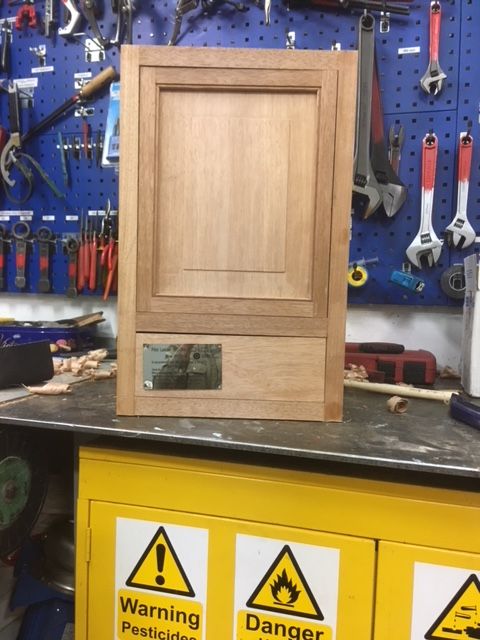
Plate mounted horizontally on door.

Plate mounted vertically on door (similar to raised panel)

Plate mounted on drawer.
(technically it could go in the center of
 the drawer, but that would require
 two pulls instead of one center pull)

Grooving /dadoeing the raised panel.

Position of plane to make the raised panel sides.

Glue up of door.


Wednesday, March 28, 2018

Pilot ladder cabinet 8, drawer with half blind dovetails

Before attaching the face frame to the carcase, I smoothed the divider between the cabinet part and the drawer part, and i also smoothed the shelf that divides the cabinet in two.
Both these two panels were slid into their mortises, and the face frame was then glued onto the carcase.

Yesterday I began making a drawer for the lower part of the cabinet.
I crosscut a piece to the desired length plus a bit more, and reduced the thickness by planing.
When I was satisfied with the thickness of the piece, I squared the ends off, and cut it to the correct length.
The piece was held in position in the opening, and I marked the height of it with a pencil.
One of the advantages of not having mounted the back panel is the possibility to do stuff like that.

The drawer front was then ripped to the correct height, and the sawed surface smoothed too.

I had made some stock ready for the sides, by resawing it, so I just had to work it a bit with a plane to make it ready for some joinery. One piece would yield enough material to make both sides, so I left the piece in full length for the moment.
Luckily the wood had remained very stable, so it was a matter of very little work to get it like I wanted it.

Out here (just like in the real world), grooving comes before dovetailing. So the Record No 50 was outfitted with a grooving iron. I paid close attention to the grain orientation of the sides and the front.
I mounted the wood using a clamp, and made some really nice grooves.
Once I had the grooves planed, I cut the sides to the correct length.

Before stopping for the day I marked out the tails on the sides, and that was about it for yesterday.

Today I have made the half blind dovetails for the front and the sides, and now I just needed a small break before making a back to the drawer as well.
I have already glued up a panel for the drawer bottom, and it should be a quick job to attach it after the drawer has been glued up.


Half blind dovetails pressed in halfway.

Setup for grooving.


Sunday, March 25, 2018

Pilot ladder cabinet 7, face frame and dadoes

Yesterday I planed the individual strips of wood that was going to form the face frame.
I spent some time deciding what type of joinery I should use. The choices were: bridle joints, half lap joints or mortise & tenon joints.
After weighing the options against each other, mortise and tenons came out on top. I think they will end up looking the best, since the cabinet will not be painted., so these offer the least amount of end grain to be seen. Only the ends of the stiles will have visible end grain, and that will be OK.

After measuring the carcase, I laid out all the joints on the parts for the face frame. I decided to allow myself approximately 1/16" overall, so I wouldn't end up with a face frame that was smaller than the carcase itself.

The tenons were sawed using a hacksaw, and the mortises were chopped out using my 3/8" chisel. It is not a mortising chisel, but if you go slow and don't use the chisel as a crowbar for levering out the wast, it is no problem for me at least - to turn out an acceptable mortise with it.

I really tried to take my time and work accurate, and mysteriously it helped. 6 of the joints were really nice and tight, and only one of them was a bit loose.

When I laid out the joints, I had tried to make sure that all the inaccuracies in thickness would be on the same side, and it went pretty well. The one side is near flat with only a minor deviation in one joint. The other side is not flat, but since it will be the outside, I can level it out after gluing the face frame to the carcase.

With the face frame complete, I could measure directly of it, to make sure that the division between the drawer part and the cabinet part would end up where it should: Behind the middle rail of the frame.
The location for that dado was laid out, and it was then used for determining the location of the other dado. That will eventually house a shelf that will divide the cabinet into two.

My usual method for making dadoes is to clamp down a batten next to the line, and use it to guide the saw. When both sides of the dado has been sawed, I remove the waste with a chisel and follow up with a router plane.
I deliberately made the dadoes a bit narrower than the partitions, so I can make a nice tight fit for them by planing the underside of them a bit thinner, just like I did on the floating panels for the back of the cabinet.
Mock up with the parts.

Mortises and short tenons.

Face frame glued up.

Setup for making a dado.